logo level
SME
Agency
Large enterprise
contactOperationalControl Panel

Redundancy in our web hosting

How do you prevent server downtime? Are you worried about unexpected outages? In the world of hosting 'redundancy' is the answer to uncertainty about uptime. But just like with most things in life, redundancy comes with nuances and trade-offs. At Level27, we help you choose the right form of redundancy, not just “more is better,” but rather: what fits best with your application? Bij Level27 helpen we je de juiste vorm van redundantie uit te kiezen, niet zomaar ‘meer is beter’, maar wel: wat past best bij jouw applicatie?

image

What exactly is redundancy?

Redundancy means that your hosting environment is built with a failover mechanism. In practice, this functions as a kind of failsafe: when one component fails, the failover mechanism automatically and seamlessly takes over. This way, your services remain operational without downtime or interruptions.

This is achieved by using multiple power sources, network connections, servers, and sometimes even entire data centers that run in parallel or are on standby.

A redundant system can guarantee uptime reliability because it runs on separate physical infrastructures, often spread across multiple data centers and supported by multiple virtual machines (VMs). In short: the system is designed in such a way that there’s no single point of failure.

You might now be wondering: “What kinds of redundant systems actually exist, and what are the differences?” Don’t worry, at Level27, we’re happy to explain it to you.

Single Setup

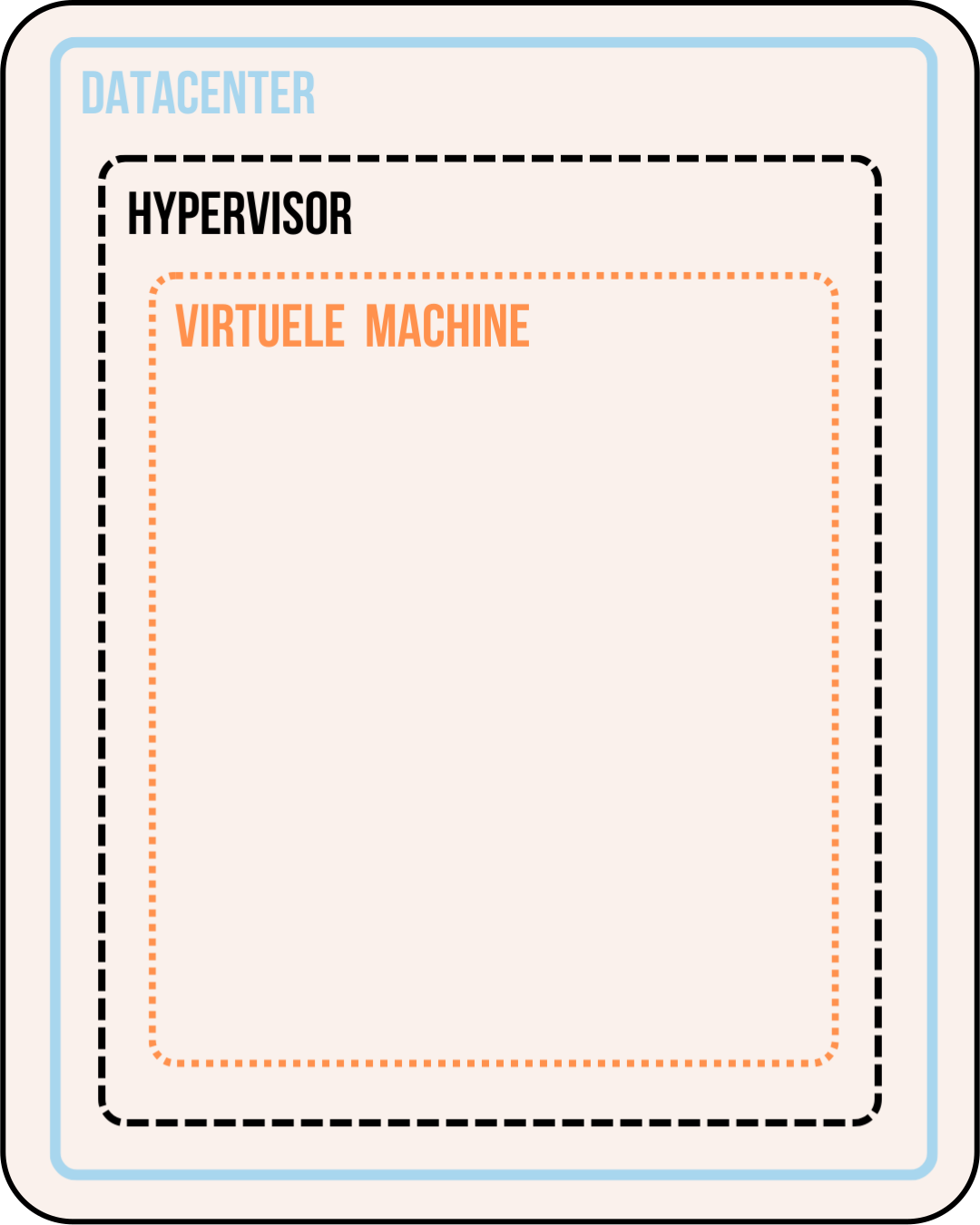
Your application runs on a single server in a data center, hosted on what we call a primary hypervisor. By default, this setup already includes built-in redundancy, such as multiple power supplies, network cards, and storage disks. For example, if a network card fails or a storage disk breaks down, other components take over and your application keeps running. If the hypervisor itself crashes, all virtual machines can be restarted on a secondary hypervisor, where data is regularly synchronized. However, starting up this backup takes time, and as a result, there is a risk that the most recent user transactions may be lost.

image

Redundant Setup at a single location

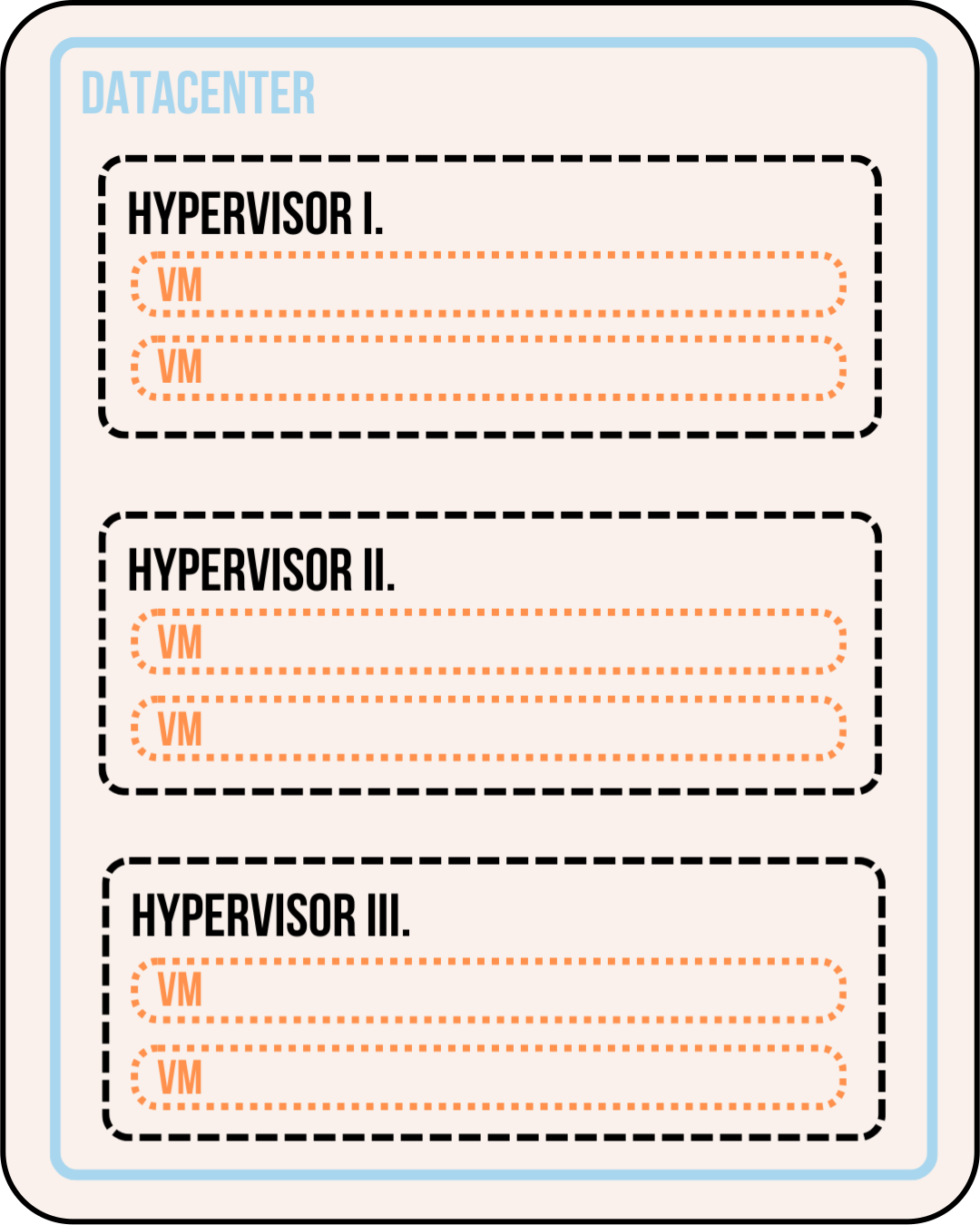
This setup builds on the single model but with one key difference. Your application is hosted on multiple virtual machines, spread across different physical hypervisors within the same data center. This makes your environment resistant to the failure of a single virtual machine, for example due to overload or a configuration error. Another virtual machine automatically takes over the workload, ensuring the application continues to run without interruption. In addition, the multiple hypervisors provide extra protection. Should an entire hypervisor fail, the virtual machines on the other hypervisor immediately take over the tasks. This makes the setup reliable in terms of failover and provides strong protection against issues at the virtual machine or hypervisor level. However, there is still a limitation, this redundancy only protects against hardware or hypervisor problems. The reliance on a single data center remains a risk. In the event of a power outage, fire, or network disruption, all your systems would still go down.

image

Redundant Setup across multiple locations

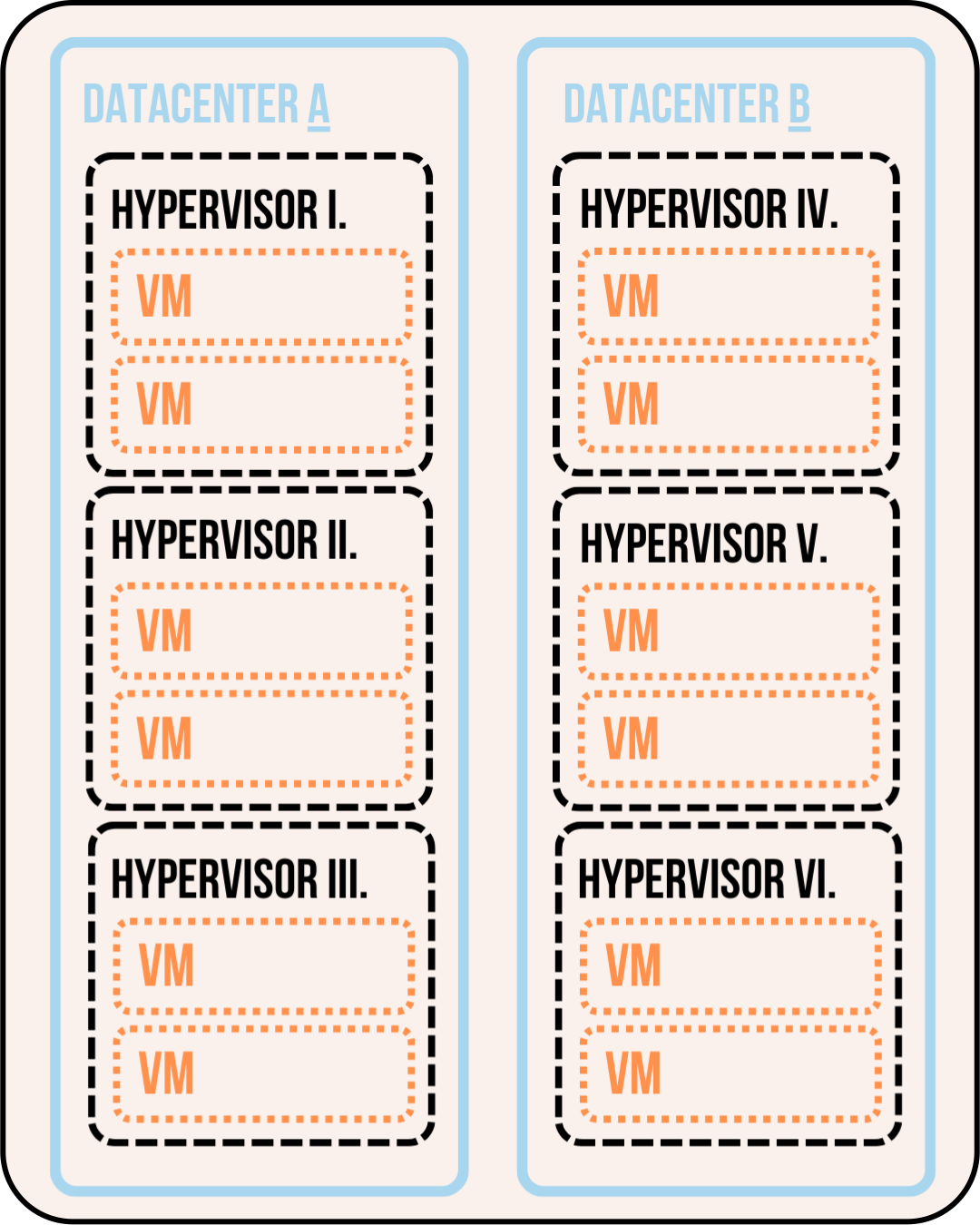
Here, redundant systems are distributed across multiple data centers located in different geographical locations. In this model, for example, your application runs both in a data center in Brussels and in a data center in Antwerp. Thanks to this geographical separation, your application remains operational even if one entire data center suddenly becomes completely unavailable. Logically, you would of course choose a redundant system across multiple locations, right? Unfortunately, this system is not a miracle cure and also brings negative consequences with it…

image
image1290

The downside of redundancy

Redundancy sounds like a no-brainer: more certainty, less risk. But this concept also comes with its own technical and practical challenges.

The biggest pitfall? Geographic distribution. As soon as your infrastructure is spread across multiple physical data centers, for example in Brussels and Antwerp, latency inevitably arises. This phenomenon occurs because data now has to travel between physical locations, via networks that are subject to distance and therefore introduce delay.

Such a setup between these two cities causes on average about 4.8 ms TCP latency. Not catastrophic on paper, but in reality it is noticeable: slower load times, delayed response times, or small lags in transactions that can add up to a significant difference in performance.

So how do you solve this latency? The trick lies in smart architecture. Important components are often duplicated per location, so most traffic stays local and only replication or synchronization tasks cross this distance. Techniques such as caching, load balancing and asynchronous replication help reduce the impact of latency significantly.

And what about data? As soon as you need to persistently store data, for example in a database, extra challenges come into play here as well. When a user saves something, such as an order in a webshop, that same write operation must end up in both locations, so that the data remains identical everywhere, or in other words, “in sync.” This can be done with sync writes (safe but slower) or via async replication (fast but with the risk that the replica is not fully up to date). In the case of a failure during async replication, this may mean that your recently stored data is lost. In short, both options impact the performance and complexity of your setup.

And that is the paradox of redundancy: you choose it to make your hosting environment more resilient against downtime or outages, but without the right considerations it can negatively affect the user experience. At Level27 we combine redundancy with a network and infrastructure design that minimizes latency, so that you get the certainty of distribution without any noticeable performance losses.

Why then still choose sufficient redundancy?

Redundancy within a single data center already provides a solid foundation. But for applications that need to be available 24/7, that is sometimes not enough. Think of e-commerce platforms, SaaS services, or API environments, where even a few minutes of downtime have immediate consequences. A short interruption can lead to revenue loss, reputational damage, and frustration among end users. The impact is often greater than you would think: a missed purchase, an unavailable service at a critical moment, or simply a user switching to a competitor. And let’s be honest; users today expect absolute availability.

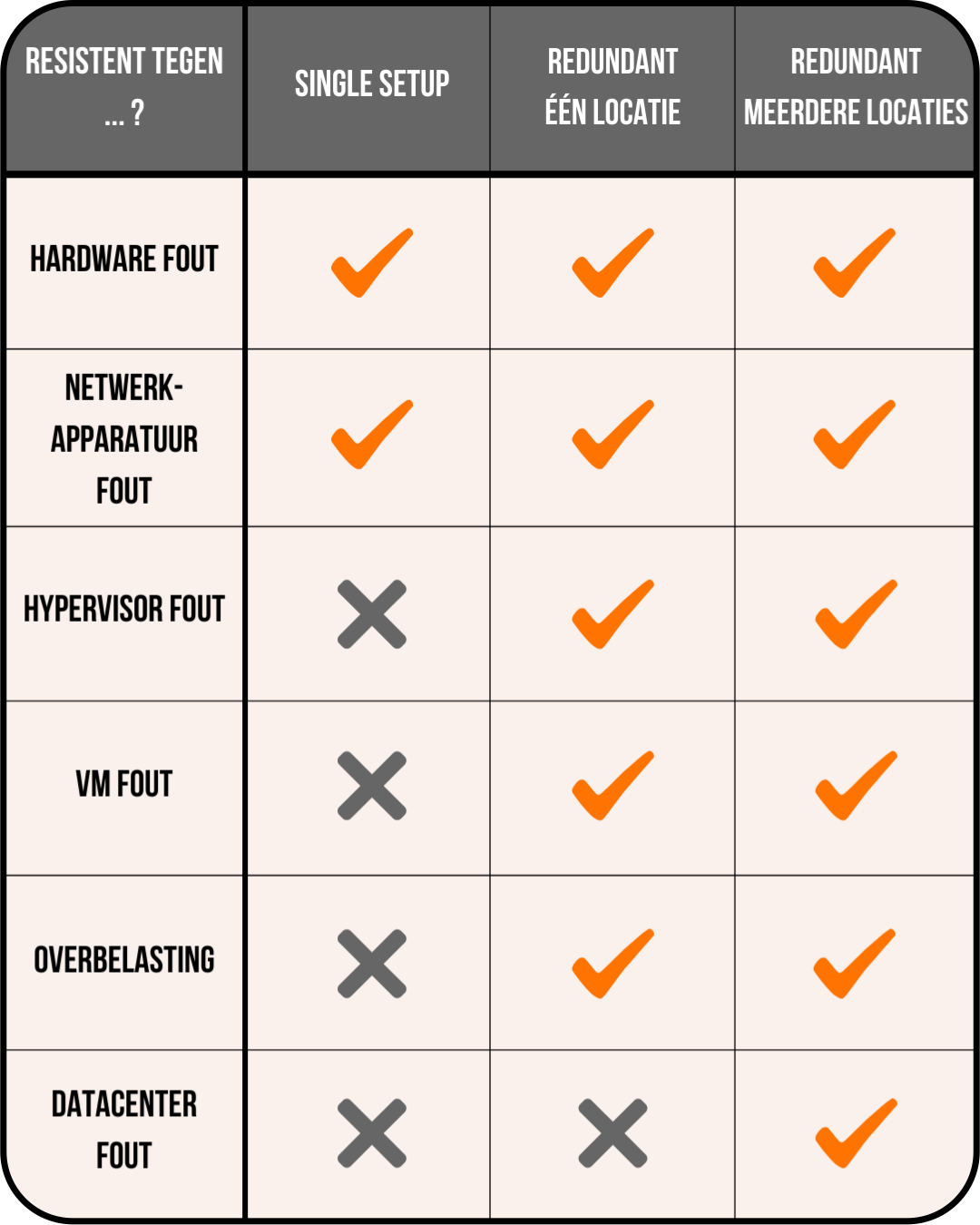
The causes of downtime are varied. Hardware problems such as defective network cards or storage systems, software errors such as corrupt configurations or updates that go wrong, or overload during peak moments, such as a popular ticket sale. Even external physical incidents in the data center, such as fire or water damage, can completely interrupt availability. Redundancy is therefore not an unnecessary luxury. It is a deliberate choice that protects you against unexpected downtime and supports business continuity, reliability, and customer satisfaction. But more importantly: choosing the right form of redundancy, tailored to your application and organization, is essential to get the most out of it. We have already created this table to help you better understand which issues can or cannot be resolved by the different models.

image
author picture

We believe in smart redundancy: enough to guarantee your uptime, without unnecessary complexity and suitable for your budget.

Thomas

Marketing Manager

Our approach at Level27: relaxed online

We believe in smart redundancy: enough to guarantee your uptime, without unnecessary complexity and suited to your budget.

At Level27, redundancy is by default woven into our infrastructure at the highest level. We work exclusively with the most reliable data centers in Belgium, which provide the necessary guarantees to ensure your availability. Each data center is fully equipped with dual power and cooling systems, so your application keeps running continuously, even during unexpected failures.

Our network connections go beyond a single backup; with triple capacity and connectivity, your application always remains accessible and communication continues to run smoothly. In addition, our data center zones have more than enough available CPU and memory resources, so that in an emergency we can scale up immediately, without wasting time searching for extra capacity.

Furthermore, at Level27 we also offer the possibility to spread your infrastructure over two or more geographic locations. We connect you to multiple data centers that do exactly the same as described above, but independently of each other. This setup significantly increases the availability and resilience of your hosting environment. Because redundancy across multiple data centers means your application is not dependent on a single location or individual components.

We are happy to combine technical reliability with practical added value. Our environment is monitored 24/7 to ensure that failover always works when needed. We provide full service on your environment, so everything continues to run smoothly, and our user-friendly control panel makes managing a complex infrastructure surprisingly simple. On top of that, we help you choose the right managed server pack, so your SLA perfectly matches your needs.

What is the best setup for you?

We do not believe in ‘one-size-fits-all’. Redundancy must be tailored to your application, your users, and your business model. That is why we are happy to help you make the right choice. Do you want to know more about how Level27 provides redundancy in our hosting environments? Then book a free consultation via the button below, we are happy to think along with you!

Book a consultation
Call us
CTA Image